YOUR BUSINESS
See what AIDA accomplished.
Revenue, opportunities, conversations, appointments, and the progress that matters.


Welcome to AIDA Command, your dedicated intelligence and operating environment. AIDA brings the ExecHero Decision Engine™ together with ARCS Adaptive Revenue Capture capabilities to create, engage, nurture, qualify, book, recover, and re-engage opportunities—so your business keeps moving and your time belongs to you.
Before you take command, a personal introduction to the opportunity ahead—and how to get the most from AIDA.
New inquiries. Existing leads. Cold and warm prospects. Missed calls. No-shows. Stalled conversations. After-hours interest. AIDA is engineered to keep the relationship moving across the opportunities your business has already earned—and the ones she helps create.

Healthcare, dental, wellness, automotive, home services, real estate, professional services, hospitality and more. The same Decision-Led infrastructure adapts to each client's offer, audience, and operating environment.
Revenue, opportunities, conversations, appointments, and the progress that matters.
The ExecHero Decision Engine™ searches for and evaluates 300+ Behavioral Decision Signals™, Decides strategy and next best action, and instructs AIDA to execute.
Explore tested variants, effectiveness, validated winners, promotions, and the next learning cycle.
See the hours, workdays, after-hours conversations, and manual effort AIDA returns to your business and your life.
Freedom isn't just another metric. It's what becomes possible when opportunity creation and follow-up keep moving without demanding every hour of your day.
The ExecHero Decision Engine™ searches for and evaluates 300+ Behavioral Decision Signals™, Decides the strategy and next best action, then instructs AIDA to execute. That instruction can change the entire way the relationship progresses—not just the next sentence.
What to ask to advance understanding and certainty.
Which positioning angle best fits the current decision state.
How to express the same offer for different decision needs.
The emotional temperature and consultative posture.
The communication approach selected for the interaction.
Where the next conversation should happen.
How SMS, email, voice and other available channels work together.
When the next action should occur.
How quickly the conversation should progress.
The pattern of outreach and follow-through.
How long to allow before the next appropriate move.
The strategy and action the Engine Decides to take next.
Two people considering the same product may need entirely different paths to reach the same decision. AIDA adapts the journey to the person taking it.
The ExecHero Decision Engine™ Decides the strategy and next best action, then instructs AIDA to execute.
Engagement, nurturing, qualification, re-engagement, and booking adapt to the individual and the opportunity.
Monitor results, inspect conversations, review intelligence, and take control whenever you choose.
AIDA brings the ExecHero Decision Engine™ together with ARCS Adaptive Revenue Capture capabilities to create, intercept, nurture, qualify, book, recover and re-engage opportunities. Monitor deployment readiness, communication channels, routing, and operational activity from one command environment.
This progression gives visibility into the operational systems required for ARCS to capture, interpret, and orchestrate revenue movement.
ARCS surfaces meaningful movement, signal detection, and revenue activity without overwhelming the operator. The goal is intelligent visibility — showing what matters, when it matters, so confidence and clarity increase without adding noise.
ARCS is designed to remove operational drag that is easy to forget once the system starts handling it quietly. This view keeps the recovered time, reduced manual work, and maintained follow-up continuity visible.
This is AIDA’s Intelligence Ingestion Layer—powered by the SDCC Way™ and Decision Science™, and equipped with ARCS™ Adaptive Revenue Capture capabilities. Together, they enable an autonomous, decision-led revenue capture system that transforms intelligence into strategy, action, and measurable revenue opportunities.
The quality of the answers provided here directly influences conversational accuracy, SDCC orchestration, routing behavior, personalization quality, CTA timing, objection handling, and decision-stage movement.
Complete each layer in order. ARCS uses these answers to align the infrastructure intelligence layers, deployment logic, AIDA knowledge base, CTAs, communication behavior, and operator visibility.
Detailed system movement, conversion intelligence, channel performance, signal detection, and learning proof.
Mission Control gives the quick operational overview. This view shows the deeper proof layer: how ARCS is detecting signals, routing intent, generating conversations, surfacing constraints, and learning from market response.
High-level proof that the system is receiving, interpreting, and moving opportunities through the capture layer.
ARCS exposes the difference between raw lead volume and actual decision movement.
A live directional read on whether the capture layer is creating enough response, booking, and route momentum.
The system identifies the dominant revenue constraint based on the relationship between processed volume, immediate routes, conversations, and bookings.
This is the difference between contacts sitting still and contacts being actively interpreted, routed, and pursued.
SMS, voice, email, and LinkedIn are interpreted as coordinated revenue motion — not isolated touches.
ARCS reads fit, activation, friction, urgency, route state, and SDCC movement to avoid treating every lead the same.
Signal counts represent observed signal occurrences, not unique people. A single lead can reveal multiple signals across several categories, and category totals overlap. The 300+ Decision Signals™ describe the detection framework—not a guaranteed number of signals per lead. This six-month demonstration uses illustrative records.
The system tracks which positioning angles, CTA paths, and message variants appear to be creating the most movement.
Highest observed movement pattern based on the current available activity.
| Variant | Movement | Status |
|---|---|---|
| FM_A | 34% | Leading |
| F2_A | 26% | Learning |
| CTA_A | 18% | Watch |
This layer gives visibility into how ARCS interprets behavioral movement across the market — adapting dynamically through decision-led orchestration rather than static automation sequences.
Revenue leakage and missed follow-up appear to be the strongest recognition hooks.
Prospects respond when the message names a hidden operational cost without blaming them.
Increase pressure on immediate-fit leads while keeping nurture cadence intact.
A visibility feed highlighting meaningful behavioral movement, routing activity, and revenue orchestration across the system.
Every lead holds potential. AIDA turns signals into intelligent action, relationships into opportunities, and consistent follow-through into measurable business momentum.
Go beyond contact storage. The ExecHero Decision Engine™ Decides the next best action and directs AIDA to advance each relationship.
AIDA adapts her communication, cadence, channels, and next move to the signals each prospect reveals.
Capture more of the opportunity you already paid to generate. Detect friction earlier, recover stalled relationships, and keep the right conversations moving.
ARCS continuously calibrates against the way prospects actually respond, hesitate, engage, object, and move. This layer gives you visibility into decision movement, signal interpretation, routing confidence, and communication performance so you can see the infrastructure becoming more useful over time.
As lead flow, replies, appointments, objections, and follow-up activity increase, ARCS uses those signals to strengthen communication timing, routing confidence, message selection, and decision-stage movement.
Early signals indicate prospects respond better when the conversation begins with recognition, context, and clear operational relevance instead of generic follow-up language.
ARCS is detecting more prospects who are not ready for pressure, but are open to guided movement when the conversation lowers friction and clarifies relevance.
More behavior creates better context. More context creates cleaner routing. Cleaner routing creates better timing, tone, and next-step orchestration.
ARCS monitors how different message patterns, CTA timing, follow-up structures, and channel behaviors influence movement. You do not need to manage this manually — the system keeps the important signals visible.
| Variant Area | Current Signal | Interpretation | Movement |
|---|---|---|---|
| First Message | Recognition-first opener | Prospects appear more receptive when the opening feels specific and relevant. | Strengthening |
| Follow-Up 2 | Consequence visibility | Light consequence framing creates clarity without increasing resistance. | Monitoring |
| CTA Timing | Direct booking path | Strongest when sent after relevance is established, not before. | Calibrating |
| Voice Handoff | Context-aware opener | Voice movement improves when AIDA acknowledges interruption and gives permission to disengage. | Active |
Even during quieter booking windows, ARCS continues monitoring conversations, maintaining follow-up continuity, nurturing dormant opportunities, and expanding the behavioral context needed for stronger movement.
Not every revenue movement immediately appears as a booked appointment. Some movement happens as conversation warming, objection surfacing, trust expansion, reactivation, reply detection, and long-term decision formation.
ARCS continues watching engagement, routing movement, reply patterns, nurture activity, and conversion signals so the system can become more useful as more real-world behavior enters the infrastructure.
ARCS is built on the principle that people do not move because they receive more reminders. They move when doubt, belief, consequence, timing, trust, and certainty are led correctly. This layer makes the decision intelligence visible without overwhelming you with unnecessary complexity. But rest assured, ARCS continuously monitors decision movement across the revenue environment: timing, hesitation, trust friction, consequence visibility, certainty strength, and behavioral movement signals so the system can adapt outreach sequencing, continuation logic, channel priority, and communication pressure with more intelligence.
ARCS shows decision movement, and buyer readiness without having to reveal the full complexity of the machinery. This gives our clients confidence that the system is interpreting buyer readiness and not blasting every prospect through the same rigid sales process, without exhausting them with complicated formulas, behavioral mapping models, and unnecessary reports.
The SDCC Way™ moves through Situation → Doubt → Consequence → Certainty. Throughout the journey, the ExecHero Decision Engine™ interprets observed signals and Decides how AIDA should guide changes in understanding, internal belief, buying state, and readiness to act.
ARCS does not force every person into the same sales path. It adapts tone, timing, density, channel priority, CTA placement, and continuation behavior based on the way the prospect appears psychologically positioned to move.
Some need speed. Some need trust. Some need consequence visibility. Some need a belief shift before a booking link is useful.
A high-urgency service lead should not receive the same communication style as a skeptical high-ticket buyer. ARCS calibrates toward the decision environment.
Prospects move through attention, relevance, doubt, belief, consequence, and certainty. ARCS was built to recognize and guide that movement.
When you want deeper mastery, ExecHero training helps your team improve sales leadership, call strategy, SDCC execution, call reviews, coaching, and internal performance.
ARCS is built from the same decision principles taught inside the Convert Clients ecosystem: Rewire minds, Convert Clients, and Scale Freedom through Decision-Led Biological Influence and Decision Leadership.
Live Call HUD™ is an optional capability available through ExecHero’s advanced Convert Clients Academy training—not included with AIDA Command. Explore how to strengthen your team’s ability to convert the appointments AIDA books.
In the application comments, identify your AIDA provider: ExecHero or Paladin AI.
Witness the intelligence behind every interaction.
Observed conversation context and relationship movement feed the Adaptive Decision Profile™.
Intelligence synthesisDecision state, certainty requirements, and next movement inform a governed execution brief.
Strategy DecidedChannel, timing, message structure, pacing, and CTA adapt to the prospect's journey.
Engagement underwayObserved context · Prospect asked for examples and proof.
Strategic priority · Establish credibility before inviting commitment.
Execution direction · Consultative tone, lower pressure, concise proof-led response.
Next action · Share relevant case evidence and offer a short review.
AIDA's conversations are the visible action. The intelligence behind each move is a coordinated decision process: observe, interpret, Decide, instruct, execute, learn.
Incoming lead context, replies, timing, language, objections, and behavior provide observable evidence.
Situation, Doubt, Consequence, and Certainty frame the relationship's current decision state and the belief shift needed.
Evaluates available evidence, weighs decision barriers, selects the strategy and next best action, and constructs AIDA's governed execution brief.
DECISION MADE → INSTRUCTIONS TRANSMITTEDLanguage-model capabilities turn the authorized brief into personalized, natural communication. AIDA executes through supported channels.
Adaptive Revenue Capture maintains follow-through, records outcomes, evaluates variants, and returns new evidence for the next Decision.
This illustrates the system architecture. A specific decision record appears as completed activity only when the corresponding events are logged.
Explore how AIDA tests, learns, and advances messaging effectiveness across the relationship journey.
AIDA creates and evaluates many variants
Qualified reply rate · 342 delivered
Qualified reply rate · 366 delivered
Qualified reply rate · 351 delivered
Voice approach is not simply a writing style. It shapes how a prospect experiences credibility, understanding, urgency and certainty. The Decision Engine Decides the appropriate approach; AIDA executes and learns from response. These are examples of the broader approach library, not proprietary signal definitions.
Invite a conversation through understanding and collaboration.
Lead with expertise, credibility, and relevant proof.
Surface the situation, friction, and true decision barrier.
Use thoughtful questions to uncover priorities.
Build understanding before inviting commitment.
Present a clear proposition and simple next step.
Acknowledge concerns and create space for trust.
Clarify the practical cost of leaving a problem unresolved.
Use evidence, examples, and demonstrated outcomes.
Reduce perceived uncertainty around the guide and path.
Focus on the positive future state and potential gains.
Reopen a dormant relationship with timely relevance.
| Variant | Delivered | Qualified replies | Reply rate | Booked | State |
|---|---|---|---|---|---|
| A · Consultative | 342 | 63 | 18.4% | 18 | Former control |
| B · Authority | 366 | 116 | 31.7% | 37 | Promoted control |
| C · Discovery | 351 | 85 | 24.2% | 24 | Challenger |
Promotion is illustrated here. Production results and governance decisions will come from the learning feed.
Your time. Reclaimed.
Every conversation handled and every opportunity advanced creates space for the life you're building.
Follow-up messages handled
Scheduling actions completed
Prospects re-engaged
Each completed activity is multiplied by the documented manual time normally required for that task. We then add the minutes and divide by 60. This is an estimated labor-equivalent, not a claim that every minute would otherwise have been spent.
Illustrative: (1,420 × 3 + 286 × 8 + 174 × 6) ÷ 60 = 126.5 hours, or 15.8 eight-hour workdays.
Adjust the per-task assumptions to match your team. Production estimates require deduplicated, logged activity counts and documented benchmarks.
The opportunities that follow-through recovers.
Many sales teams concentrate their effort in the first few attempts. Persistence Intelligence makes the later journey visible—showing the additional touches AIDA makes, the conversations reopened, and the appointments that arrive beyond a typical five-attempt follow-up policy. As attribution data becomes available, clients can see which of those later-stage opportunities become actual revenue. Results here are illustrative until connected to live activity.
| Attempt range | Replies | Bookings | Share |
|---|---|---|---|
| 1–4 | 183 | 62 | 62% |
| 5–7 | 67 | 19 | 19% |
| 8–10 | 41 | 12 | 12% |
| 11+ | 20 | 7 | 7% |
AIDA creates and advances opportunities. Your team converts them.
AIDA is governed by the ExecHero Decision Engine™, built on Decision Science™ and the SDCC Way™—methodologies developed through more than $1 billion in influenced decisions across industries. Your team can learn the same decision-centered principles that power the intelligence: how to recognize what matters, strengthen certainty, guide conversations, and Convert Clients.
A modest investment in field-ready books and professional development can be small compared with the value of converting even one additional qualified opportunity. The stronger the team, the more of AIDA's work becomes revenue.
Equip SDRs and Closers with books they can study, revisit, and use as practical field references—questions, reframes, frameworks, closing approaches, and decision tools at their fingertips.
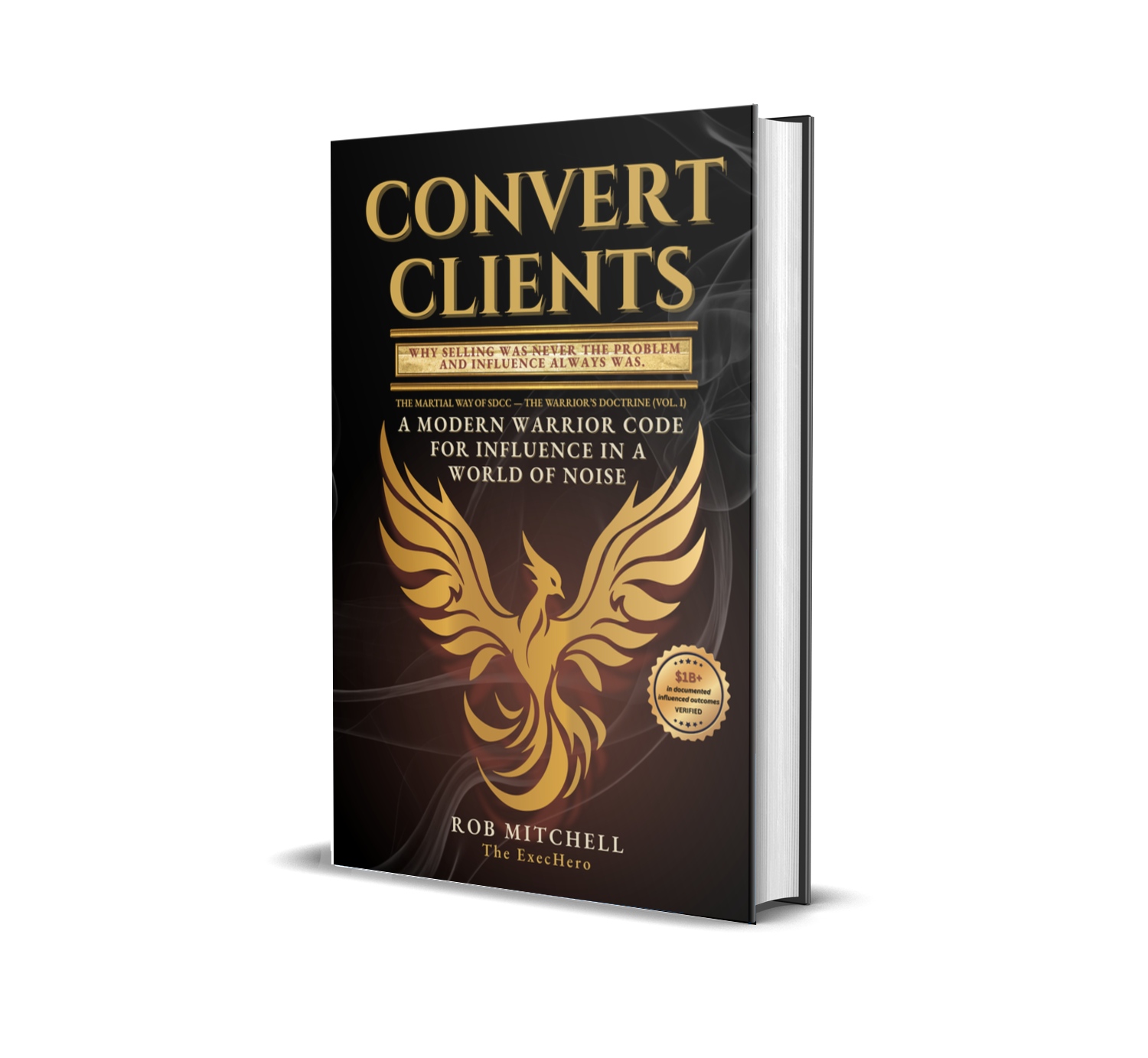
Foundations of the SDCC Way™, decision leadership, influence and closing.
View on Amazon ↗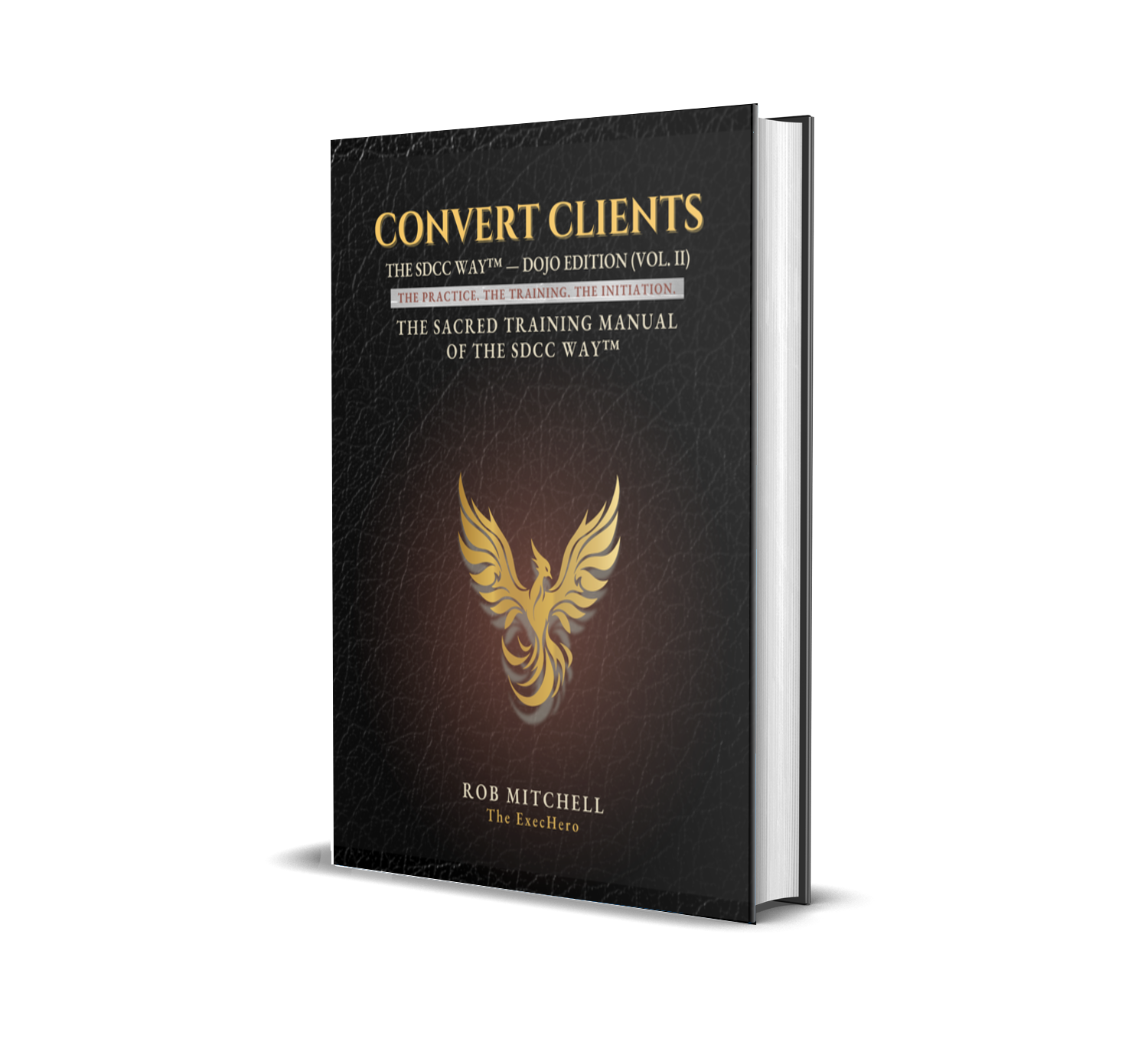
Turn principles into trained habits with practical drills and field application.
View on Amazon ↗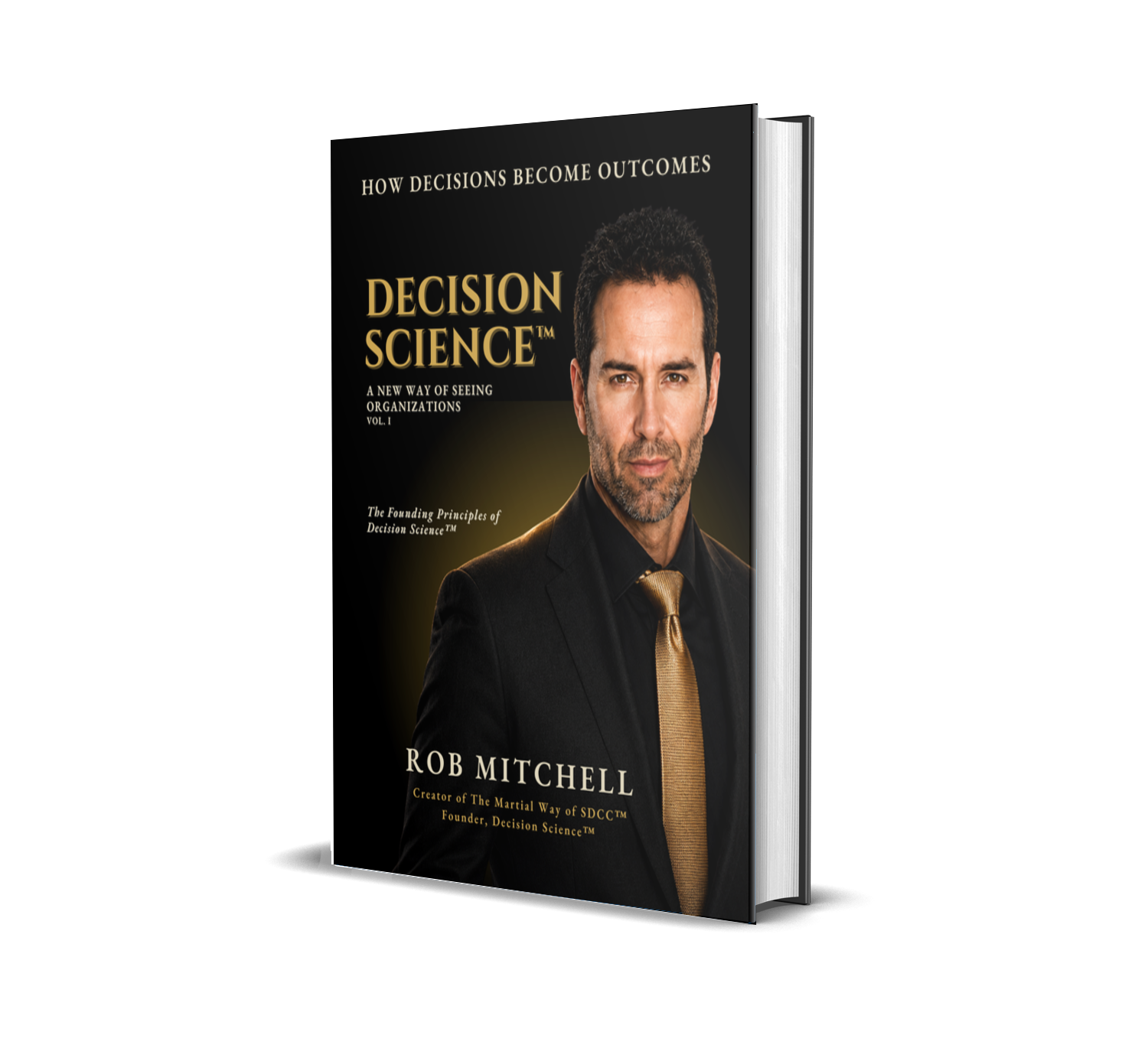
Understand why decision quality shapes execution, leadership and outcomes.
View on Amazon ↗
Develop the discipline, philosophy and practice behind becoming better.
View on Amazon ↗COMING SOON · Convert Clients™ Sell by Numbers — the field-ready system for turning sales activity into measurable, repeatable conversion performance. Discover how to read the numbers, find the constraint, and make every next move count. The next volume is in development; watch for its release.
Provide the core books as required reading and keep them available as working field guides for preparation, live conversations, and review.
Advance beyond reading into guided application and higher-level development with ExecHero founder Rob Mitchell. Academy enrollment includes access to the ExecHero Practitioner’s Forge—specialized Decision Performance Infrastructure for sales practitioners.
Generate one-click SDCC frameworks, preparation structures and Decision Intelligence briefs for the conversations ahead.
Augment SDR and Closer calls—including supported Zoom workflows—with live guidance, decision-stage context and suggested next moves.
On-demand post-call reviews, pattern analysis and opportunities for improvement.
Converse with Rob's AI Twin for decision-centered practice, guidance and learning reinforcement.
The Academy and Practitioner’s Forge are separate ExecHero offerings; their capabilities are not included automatically with AIDA Command.
Explore how Convert Clients Academy equips you and your team with decision-centered training, advanced influence skills, and Practitioner Edition tools.
In the application comments, enter the company you purchased AIDA from: ExecHero or Paladin AI.
This guide exists inside the Command Environment so our clients can understand the system, upload leads correctly, review conversations when desired, and know what ARCS is doing without becoming dependent on support for every operational question.
ARCS is complete revenue infrastructure — not a minor improvement to a sales process, not a chatbot, not a basic CRM workflow, and not disconnected follow-up automation.
Traditional systems store leads and wait for people to remember what to do. ARCS captures, interprets, routes, and orchestrates movement.
Instead of sending rigid reminders, ARCS adapts communication timing, tone, density, channel behavior, and next-step logic based on buyer signals.
AIDA works behind the scenes to respond, continue conversations, guide prospects, and help opportunities move toward conversion.
Start with this SOP for step-by-step answers, then use the AIDA Command chat bubble at the bottom of your screen for quick guidance. This support assistant is a different, purpose-built technology from the outreach AIDA used in ARCS: it is designed for direct, concise operational answers rather than extended decision-influence conversations. When you need a person, Client Success is available Monday–Friday, 11:00 AM–6:00 PM Central Time.
You can also import leads directly into ExecHeroGO. For brand-new leads, no ARCS tags are needed. Simply import the contacts correctly and ARCS will handle the appropriate routing path. If a prospect calls your dedicated ARCS phone line, or sends an SMS, the system will automatically create a contact record and route them into the system for Rapid Intercept and Deep Intelligence enrichment — automatically.
Before importing older or dormant contacts, add the bypass tag so the Rapid Intercept and Universal Intake workflows do not immediately process the entire list.
EH-ARCS-BYPASSAdd this exact tag to older leads when importing them into ExecHeroGO. It bypasses both Rapid Intercept and Universal System Intake so they are not processed by Deep Intelligence immediately.
eh-ra-reprocessWhen you are ready to release a batch, remove EH-ARCS-BYPASS from those contacts and add eh-ra-reprocess to trigger reprocessing. Release up to 200 older leads per day under your deployment guidance.
Use the bypass process for dormant lists; do not add bypass tags to ordinary new-lead imports. Check campaign readiness and outreach authorization before releasing a batch.
This is the simplest path for clients who want to upload lead lists directly through the ARCS Command Environment interface versus uploading within the Contacts area of the ExecHeroGO Command Layer.
Upload lead lists directly into the ARCS intake layer for enrichment, routing intelligence, orchestration preparation, and revenue movement activation. Designed for simple operational intake: upload file, confirm mapping, and activate processing.
When leads are uploaded, ARCS™ stages them through the Deep Intelligence Layer in controlled processing cycles. During this process, the ExecHero Decision Engine™ interprets available context, evaluates proprietary Decision Signals™, identifies potential buyer movement, and Decides the appropriate strategy and next best action before instructing AIDA to execute.
Daily Deep Intelligence Processing Capacity
AIDA Command™ is designed to accommodate approximately 400 leads per day through Deep Intelligence processing, including both newly acquired leads and existing leads imported from your database.
This is a daily processing capacity guideline — not your plan's monthly Deep Intelligence allowance.
Your monthly processing allowance, applicable usage charges, and billing arrangements are governed separately by your selected service plan. The daily guideline simply reflects the approximate number of leads that can move through Deep Intelligence preparation within a typical 24-hour period, whether they are new prospects or existing database contacts.
Unlimited Ongoing Communication Activity
The Deep Intelligence processing guideline does not limit AIDA's ongoing communication capabilities. Once leads have been prepared and routed, AIDA and ARCS™ can continue managing activity across supported channels without a Deep Intelligence daily activity cap, including:
• Outbound prospecting and outreach attempts
• Incoming replies and ongoing conversations
• SMS messages and email communications
• AI Voice interactions and phone calls
• Follow-up sequences and appointment booking
• Long-term nurturing and lead reactivation
• LinkedIn and social outreach content creation
• Continued relationship development and engagement
In short: Deep Intelligence processing capacity governs lead preparation — not how many conversations AIDA can manage or how many outreach activities she can execute.
Standard communication usage charges, channel requirements, and applicable platform policies continue to apply.
Large Lead Uploads
Have a larger database? No problem. AIDA Command™ supports large lead imports. When an upload exceeds available daily Deep Intelligence processing capacity, ARCS™ queues the remaining leads and processes them in structured waves.
This approach helps maintain processing stability, personalization quality, and consistent decision intelligence without requiring you to divide your database into multiple uploads manually.
If your business requires higher daily Deep Intelligence processing capacity, simply contact Client Success to discuss custom capacity options.
Your opportunity pipeline can keep growing. AIDA is built to keep working.
Use Direct Lead Intake when you want to quickly inject a single opportunity into the system without preparing a CSV upload.
The submitted lead data has entered the ARCS intake layer and is queued for decision-led processing, scoring, routing, orchestration, and revenue movement analysis.
When existing contacts need updated fields, regenerated messaging, refreshed intelligence, or renewed routing, clients can update them through the same ExecHeroGO import flow.
Use eh-ra-reprocess only when contacts were previously imported incorrectly, are missing important information, or are existing contacts being intentionally updated.
This helps prevent contacts from being unnecessarily routed through the Deep Intelligence layer again and helps avoid additional usage charges for leads that have already been processed by ARCS.
For brand-new lead uploads, do not add this tag. Import the leads cleanly and allow ARCS to route them.
The best long-term lead flow is not manual upload. The best path is connecting landing page forms so leads automatically enter ExecHeroGO and ARCS without delay. When new leads enter through your forms, no ARCS tags are needed.
When forms are connected, inbound prospects can be captured and routed quickly without waiting for a manual CSV upload.
Rapid Intercept is designed for speed-sensitive opportunities where immediate response can improve connection and conversion outcomes.
Connected forms help ARCS become more autonomous by reducing human delay, missed uploads, and inconsistent lead handling.
Inside ExecHeroGO, navigate to Sites & Funnels → Forms and create your form. In the form builder, copy the embed code, then give that code to your website or funnel developer to install as the contact form on your page.
At minimum, collect Contact Name and Email Address, and make both required. For the full AIDA experience and ARCS capabilities, we recommend a required Cell Phone field so AIDA can call and message leads as well as email them.
Requiring a phone number may reduce the number of submissions, but often produces stronger contact information and more committed inquiries. AIDA works with email-only leads; a valid mobile number gives her additional ways to engage. The choice is yours. Decide well.
ARCS can include a website conversation layer that allows prospects to engage directly with AIDA from your site. This is not a standard chatbot. It is a front-end conversation entry point governed by the SDCC-Trained Intelligence Layer. Your active enrollment in ARCS includes the website conversion layer. Email [email protected] (ExecHero clients) · [email protected] (Paladin AI clients) if you would like the code to add to your website. Note: The code will need to be added within your website’s html code, simply hand it to your developer and they will know how to properly insert it. If you do not have a developer, we offer additional support options to handle it for you.
Visitors can click the conversation bubble and begin interacting with AIDA instead of waiting, leaving, or getting lost in a static contact form.
Depending on your connected configuration, prospects may be able to engage through live chat, SMS-style conversation, voice call pathways, email, Messenger, Instagram DM, WhatsApp, or other supported conversation channels.
AIDA is calibrated to use SDCC, Biological Influence, and Decision Leadership principles to guide prospects toward the correct next step: booked call, service call, quote, estimate, application, or consultation.
A2P verification helps carriers confirm that your business is sending compliant business messages. This protects message deliverability, reduces filtering risk, and supports healthier SMS communication. Each ARCS seat includes one dedicated ARCS phone number and A2P verification submission on their behalf. Additional phone lines and verification assistance can be added at any time as separate purchases. For Practitioner Edition members, ARCS phone numbers and A2P verification assistance are not included with your Practitioner Edition seat but can be purchased separately. Email [email protected] (ExecHero clients) · [email protected] (Paladin AI clients) for specific details and pricing.
Carriers want to know who is sending messages, why they are sending them, and whether the use case is legitimate. A2P helps establish that trust.
Proper verification can reduce the chances of compliant business messages being filtered, blocked, or treated as suspicious traffic.
In most cases the process moves quickly, though it can take up to a week. This timing is controlled by the verification providers and carriers, not ExecHero.
The ARCS capabilities included with all AIDA and Decision Performance Infrastructure Deployments, uses different processing paths depending on the lead, source, urgency, and available data. This allows the system to move quickly when speed matters and go deeper when intelligence matters.
Rapid Intercept is used when immediate engagement matters. It can help AIDA respond quickly, start a conversation, attempt contact, or move a prospect toward the next action before attention fades.
Best for inbound leads, paid leads, urgent inquiries, form submissions, quote requests, or service-sensitive opportunities.
Deep Intelligence processing enriches context, interprets business details, maps behavioral Decision Signals and Adaptive Decision Profiles, prepares more personalized communication, generates adaptive outreach assets, and tailors the entire sales process to align with how the person subconsciously decides.
The current Deep Intelligence rate for all leads processed above your plan’s allowed monthly lead total, is just
$3.00 per processed lead.
You are only debited based on actual usage, ensuring you only pay your fair share and not a penny more.
Overages are initially debited twice per month from the same payment method stored securely within ExecHeroGO’s Wallet feature. As usage amounts rise, we reserve the right to debit at more frequent intervals.
You can review AIDA’s work directly inside ExecHeroGO. This gives you visibility into messages sent, replies received, conversation movement, and how prospects are guided toward the desired next step.
Most operational answers live inside this Command Environment so you can move quickly, stay clear, and avoid unnecessary back-and-forth. When something needs our team, your Client Success Team is here to help.
Most lead upload, import, billing, conversation visibility, and system behavior questions are answered inside this Command Environment.
Use the AIDA Command Chat Feature Second After reviewing the SOP if you are still unclear, click the chat bubble at the bottom of your screen. There you will meet AIDA Command, a dedicated AI designed specifically to get you answers to common system questions fast.
Unlike our AIDA Relationship Engine, AIDA Command is engineered to be direct to save you time.
However, if after viewing the SOP and consulting AIDA Command, you still have questions, or if you simply prefer human help, the next column outlines how to contact Client Success.
Whether you consult with our intelligent tools or incredible team, know this:
We are always here to serve you.
You will find the Client Success Team email address for both ExecHero and Paladin AI below.
Please contact only one support team. Emailing both ExecHero and Paladin AI will not accelerate your response and may actually delay resolution by requiring additional coordination between teams.
For the fastest assistance, contact the company through which you receive your services. Our teams will coordinate internally whenever necessary to ensure your request reaches the right people.
Both teams are notified through the shared support process. Using your enrolling company's channel keeps cases organized.
Client Success office hours: Monday–Friday, 11:00 AM–6:00 PM Central Time.
Lead capture, routing, follow-up, recovery, and adaptive orchestration infrastructure are now active. ARCS is prepared to receive opportunities and begin revenue capture operations.